• Damsel (2024) by Juan Carlos Fresnadillo

    In Damsel, there is a clear fantasy narrative which, while being quite unoriginal, it proves well to analyse for narrative theory. Fresnadillo has used numerous narrative theory techniques, such as Propp’s Character functions, Todorov’s Linear Narrative Structure, and Vogler’s Hollywood three-act structure.
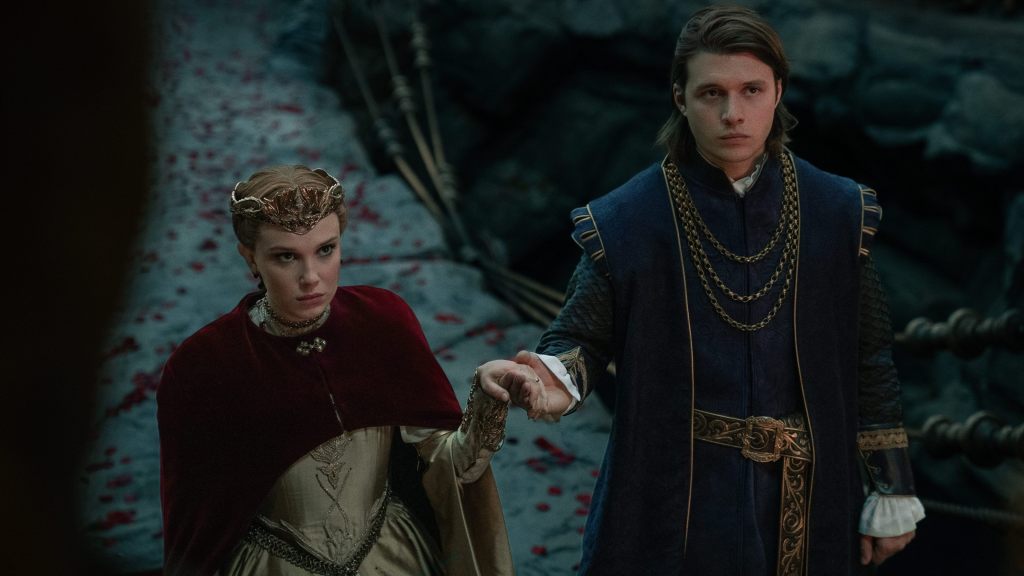
    Vladimir Propp highlighted 7(8) character functions. Fresnadillo doesn’t completely follow these but certainly uses them to help create a textbook story. The first Character function is the Hero. The Hero in Damsel is certainly Elodie, she is thrust into a dangerous situation, then must survive, escape, and ultimately confront both the dragon and the corrupt royal family that sacrificed her. Next is the Villain, who seeks to destroy the Hero. In this case, the villain could be seen as both The Aurean royal family and the Dragon. The Aurean family/Queen Isabelle serve as the villains as they orchestrate a cruel ritual, betray Elodie, and perpetuate a sacrificial system to maintain power. The dragon also initially functions like a villain: it’s the terrifying force to be feared, the “monster” to be overcome or reasoned with. Then there is the false hero who seems to help the hero but is actually a crucial factor to the fall of the hero. Prince Henry could be seen as a kind of “false hero” (or at least a betrayer). He is outwardly the charming prince, but complicit in the ritual and wields hidden cruelty. He’s not a genuine saviour. The next few are the helper, dispatcher and donor, these are the people who contribute to the success of the hero. You could argue that Queen Isabelle functions somewhat like a dispatcher: she sends (or lures) Elodie into this sacrifice ritual under false pretences. However, Lord Bayford (Elodie’s father) might also play a dispatching role by encouraging/facilitating the marriage, though his motivation is complicated (his duty to his people against the love for his daughter.) The glowing slugs/worms in the cave act like a donor, they heal Elodie’s burns, enabling her to continue her journey. Later, the dragon itself becomes a helper, after Elodie unmasks the truth, she heals the dragon and gains its trust, turning a classic “monster” into an ally. Finally, there is the princess and the princess’ father, which logically would be Elodie and her father, Lord Bayford. Elodie is the “princess” trope, but flipped: she’s not just a prize to be won, she’s sacrificed, then becomes active, resourceful, and saves others (including herself and her sister (perhaps suggesting her sister, Floria, is the actual “princess”)). And Lord Bayford as the Princess’ father, he organises the marriage of Elodie and Prince Henry. These last two are extremely conventional as the princess and the princess’ father are actually the princess and her father. 

    Using the conventional Todorovian linear narrative structure, we can identify which parts of the story Fresnadillo labelled each one as. These are as follows, the equilibrium, the disruption, the quest (recognition), the conflict (repair), the new equilibrium. Firstly, the equilibrium is Elodie’s life in her kingdom before the wedding. The disruption is the wedding betrayal and the ritualistic sacrifice to the dragon. Then comes the quest (recognition) which is Elodie’s realisation about the truth about the Aurean kingdom, the past sacrifices, and the dragon’s motive. Next is the conflict (repair), her escape, survival, confrontation, rescuing Floria, and toppling the Aurean royals. Now finally, is the new equilibrium, with Elodie and her family returning home with the dragon and establishing a new, peaceful order. I would say that this film is structured very conventionally but with just a few anomalies. For instance, the equilibrium at the start is already unstable. Todorov’s equilibrium is normally peaceful, safe, and genuinely stable, but here its not. Elodie’s family is already struggling financially. The marriage is not romantic – it’s a political trade. The Aurean kingdom feels “off” even before the disruption. This means the equilibrium is fake or fragile, which is more modern than Todorov’s original idea of a clear, peaceful starting point. 

    Vogler’s three-act structure is very common amongst modern films, here in Damsel it is presented well. In Act 1, it is split into three parts, the hook, inciting event, and the 1st plot point. During the hook, Elodie’s family struggles to survive in their harsh kingdom; the sense of desperation and responsibility sets the tone. We see Elodie caring for her people – establishing empathy. This hooks us emotionally and sets up her moral character before the plot begins. In the inciting event – a representative of Aurea arrives with the offer of marriage to Elodie. This triggers everything: The alliance, the journey, the deception, the sacrifices. It’s the moment the narrative begins. The last of the first act, the 1st plot point. The wedding betrayal and Elodie being thrown into the dragon’s pit is the first plot point. This is the point where she crosses into the “new world” (the cave). Here the real conflict begins and there is no going back. This beat marks the irreversible shift. The first pinch point is the beginning mark of act 2. Here, it is Elodie’s first direct encounter with the dragon in the caves. This reinforces: The danger, the scale of the threat and the fact she is alone and outmatched. This is a classic pinch point – antagonist pressure increases. Now its the midpoint (second plot point), Elodie discovers the truth about the past sacrifices and the Aurean family’s generational ritual. She pieces together the carvings and bones, and realises the kingdom intended to kill her. From this she pulls through and escapes the cave. Next is the last of act 2, the second pinch point. Floria is captured and prepared for sacrifice by Queen Isabelle. Elodie realises the threat isn’t just to her – it’s spreading to her family. The stakes jump again. We then finally move on to act 3, where we reach the climax and see the resolution. The third plot point is that Elodie must re-enter the cave to rescue her sister, and while doing this befriends the dragon. This leads onto the climax, where the dragon turns against the Aurean royal family and destroys them. Elodie and the dragon unite against the corrupt system, and the centuries-long cycle of sacrifice ends. This is a very conventional way of using the three-act structure, which gives the spectator a satisfying film and ending.
  • Lucy (2014) by Luc Besson

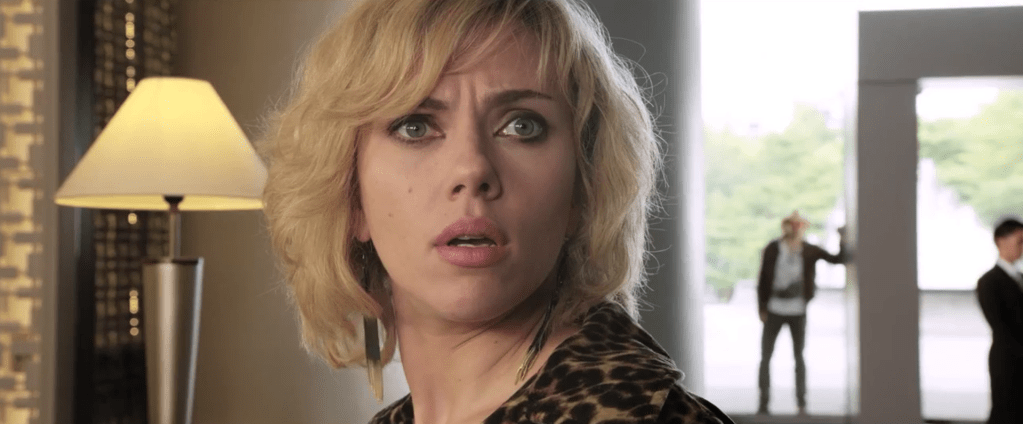
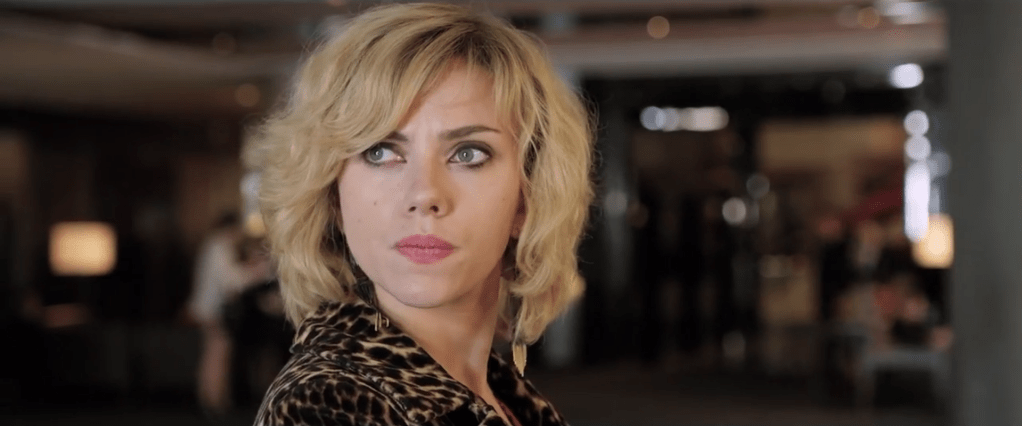
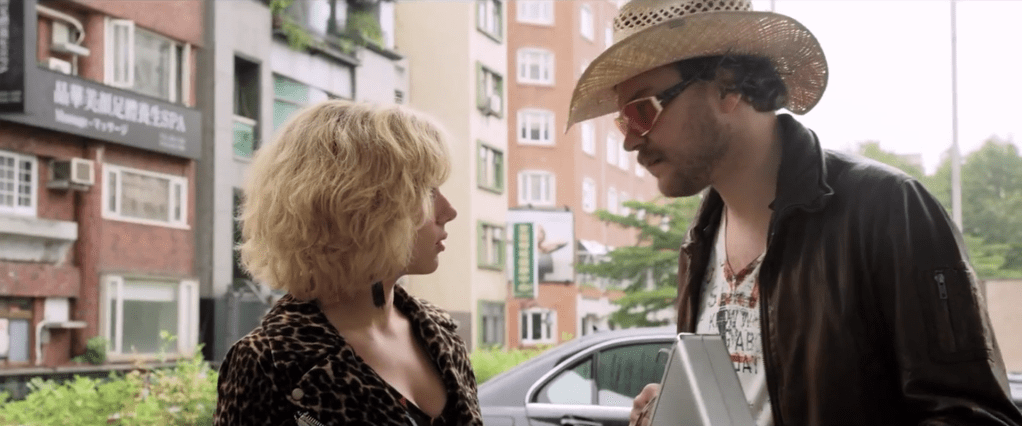
    In this opening scene from Lucy (2014) we see Scarlett Johanson’s character Lucy conversing with some other characters outside a hotel before she is taken away/kidnapped following her conversation with the reception staff. All 5 key micro-elements of film (cinematography, mise-en-scene, performance, sound and editing) are used to their fullest potential here. 

    We see Luc Besson’s interesting choices of cinematography such as a large amount of medium close-up shots, as well as some extreme close-up shots. He also uses shot/reverse shot rather frequently, during the speech moments of the scene. We see the use of tracking shots to follow the bodyguards as they move through the building, as well as tilt when we first get to see the bodyguards. At the beginning of this scene, the handheld camera is slightly shaky and unstable, showing that when Pilou Asbæk’s character, Richard, pressures Lucy into delivering the briefcase to Mr. Jang, it reflects Lucy’s loss of control and vulnerability or unwilling to the situation. It creates tension and realism for the spectator as we see Lucy’s rationality; it visually puts us in her anxious, unstable mindset. Then, the medium close-ups on Lucy’s face – especially her eyes and expressions – emphasise her emotional state (confusion, fear, disbelief, etc). Here the camera prioritises her vulnerability over the situation’s action. It’s about her experience, not the crime itself. Lighting is also key in this sequence, one great example of this is the Bright daylight outside the hotel vs the harsh, artificial interior lighting when she’s taken inside. This could be a visual metaphor suggesting Lucy is crossing from a normal world (light) into the dark, criminal underworld (shadow). 

    Luc Besson’s decisions for mise-en-scene are equally interesting. We get a flashback from Lucy right away about a night where they are out drinking, doing drugs, etc, presumably the night before, and both Lucy and Richard are in the same clothes as that flashback, suggesting that their costume design is implying the type of lifestyle they have, which could also suggest the reason why they get involved in this world. The briefcase is the main/central prop in this scene. It’s mysterious, sleek, silver, and cleanly designed which symbolises the temptation, control, and transformation. It’s modern, almost sci-fi appearance foreshadows the technological/evolutionary themes later in the film. And also, the fact that Lucy doesn’t know what’s inside reflects how she’s being drawn into a world beyond her comprehension, she’s literally holding her own future without knowing it. The setting is a bright, public space, bustling with normal life with people walking, traffic moving, and natural daylight. It symbolises safety and normality. Lucy still has some control here; the world around her feels familiar and open. However, within the hotel, suddenly, the environment changes to cold, sterile, and claustrophobic. Long corridors, closed rooms, glass, and metallic surfaces are all there is to see. Therefore, the sterile corporate setting mirrors how Lucy is going to be treated later, as an object in a transaction, not a person. It also contrasts life (outside) vs. control and death (inside) 

    The performance in this scene is noteworthy because it shows the spectator what the characters are ‘actually’ like – before the theme of the film changes, this can be seen here with Lucy’s body language. At the start of the scene, Lucy stands loosely, shoulders relaxed, she’s natural, casual, even slightly flirtatious when talking to Richard. However, once he tries to make her deliver the briefcase, her body tightens. She crosses her arms, steps back, and shakes her head. This shift from openness to defensive posture reflects her loss of safety and growing anxiety. Her body language communicates fear and resistance long before she says anything directly about the situation. Lucy is pulled and pushed through most of the scene, literally manhandled. So, Scarlett Johanson’s performance here is showing the way that Lucy is physically moved like an object, highlighting her powerlessness and sets up the film’s later theme of reclaiming control over her body once the drug is inside her. 

    Throughout the sequence there are cutaways which go straight into silence. The sound choices here are very rich with meaning. Such as when Lucy realises, she can’t escape, there’s a brief drop in ambient sound during a cutaway, leaving almost total silence before the next burst of action. That silence acts like a void of control, it isolates Lucy’s fear and forces the audience to focus entirely on her emotions. Alternatively, as Lucy’s panic grows, the background synchronous sounds seem to fade out slightly, the world becomes quieter, while her breathing and heartbeat grow louder.  This pulls us into her subjective experience which means that we hear the world as she does, in a state of panic and tunnel vision. Inside, the reverb and echo of voices in the hotel corridors make the space feel larger but more confining. This could be an auditory metaphor for entrapment. 

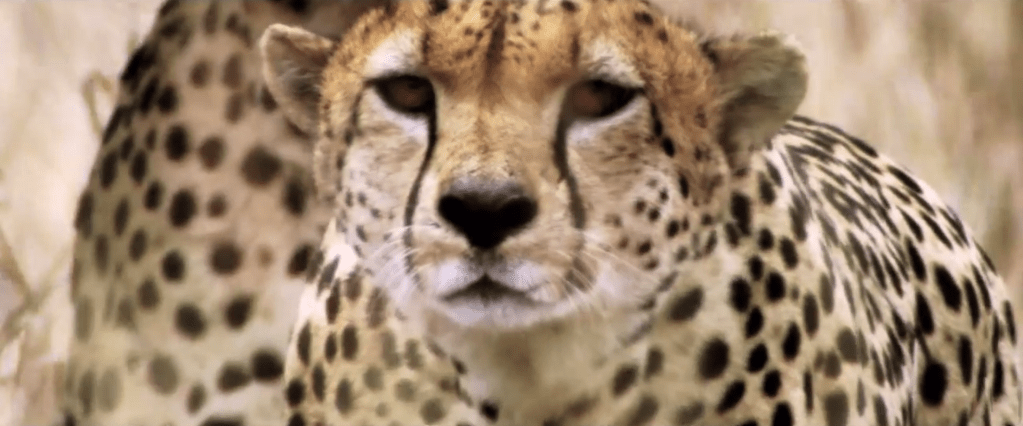
    Finally, the editing in this scene is almost genius, Besson uses match cuts and juxtaposition between the animal world and the human one throughout the build-up to Lucy’s abduction, Besson cuts, using discontinuity editing, between the live-action narrative (Lucy outside/inside the hotel) and shots of a cheetah stalking a gazelle. The cross cutting starts subtly – quick flashes lasting less than a second – but becomes faster and more frequent as the tension rises. This montage sequence mimics a predator closing in. Each cutaway tightens the tension, foreshadowing Lucy’s capture while positioning her as the gazelle and Jang’s men as the cheetah. The animal footage doesn’t just create suspense; it is used to create a metaphor. It suggests that what’s about to happen isn’t random crime but nature’s law of survival. It reframes human behaviour as animal instinct – a theme that runs through the film’s later ideas about evolution and biology. When Lucy is finally grabbed, the sequence cuts sharply to the cheetah’s pounce and the gazelle’s struggle, which is a visual metaphor for predation and loss of control. The timing of that cut; synchronising the animal kill with Lucy’s abduction; merges her experience with primal nature, implying that intellect and civilisation are illusions under threat. 

  • Alien (1979) by Ridley Scott

    In this chosen scene from alien (1979) we see Harry Dean Stanton’s character Brett get killed by the alien, and the lighting is very interesting in this scene to analyse. In the very first few seconds of this clip, lighting is shining from the left side of the shot onto the left side of Bretts face. In this medium close-up, you would call this type of lighting as a ‘Fill Light’, as this light is placed to the side of the subject, to fill out the shadows and balance the ‘Key Light’. This low-key lighting emphasises the contours of the subject by throwing areas into shade, and also this low-key approach creates a sense of claustrophobia and mystery. 

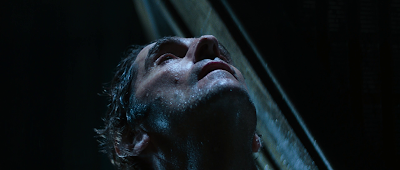
    In this next shot, brett has moved towards the centre of the room where there are chains hanging, water falling and light shining down from above. This type of lighting is known as top lighting – this highlights the subjects facial features and shows their key expression in the moment. This shot was a close-up and shows only his head, and so could also be a reaction shot, which is emphasised by how the lighting is placed above him. The wet, glistening look from his sweat and the falling rain is enhanced by the way the top light reflects off the skin. It makes the environment feel hot, humid, and uncomfortable, while also hinting at fear or exertion. 

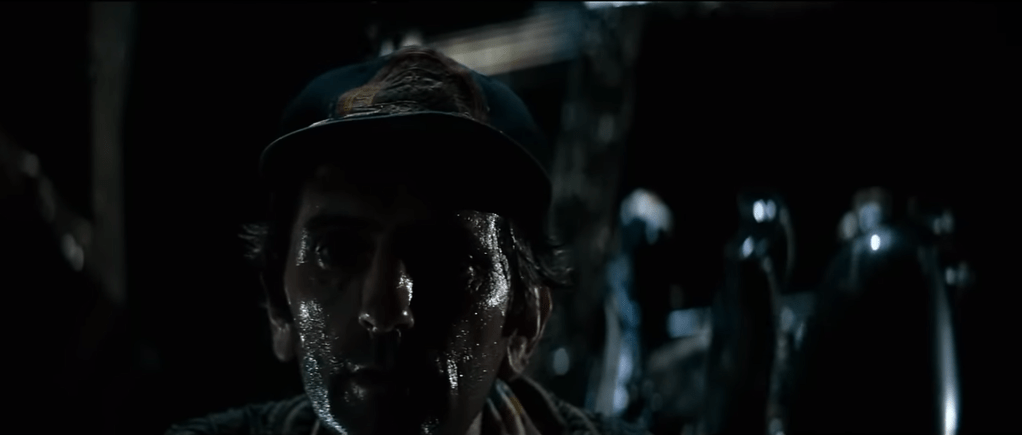
    After brett moves on from this shot, we later get to see him after he’s found the cat (Jonesy) he was searching for, and in this shot, both Brett and the alien (xenomorph) are seen, with the alien being more highlighted through the extreme ‘Low-Key Lighting’ as well as the ‘Chiaroscuro Effect’ on Brett’s face, this takes the spectators point of attention away from Brett, and onto the imminent death the alien symbolises. The alien’s bio-mechanical design (the ridges, gloss, and curves) blends almost seamlessly with the industrial machinery of the Nostromo. The lighting gives us just enough of a reflective highlight to hint at its presence, but not enough to clearly define its shape. This forces the spectator to “search” the frame, creating suspense. In the earlier shot, the sense of dread came from his own vulnerability. Here, the light finally tips us off to the presence of his killer. It’s like the lighting scheme walks us through the process of realisation: first fear, then revelation, then death. 

  • “28 Years Later” 2025 Danny Boyle.

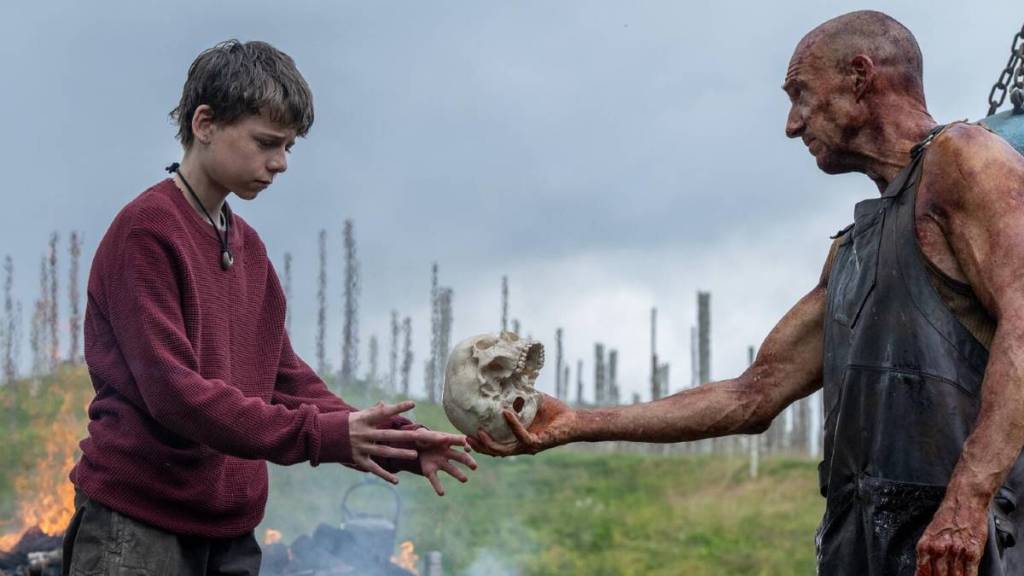
    In this shot from “28 Years Later” by director Danny Boyle, there are three main subjects that we as the spectator get our attention divided between. Firstly, there is Alfie Williams’ character ‘Spike’ on the left being handed a human skull (his mother) as the second main subject, by Ralph Fiennes’ character ‘Dr. Kelson’ on the right. This division of the subjects show the relationship between the characters and the human skull. The shot type is a medium shot and perhaps a master shot, as it’s showing all the subjects in the scene and encompasses the environment. With two of the subjects on either side of the screen it balances the shot well and creates an open environment/area for both their emotions, creating a dramatically and emotionally intense scene. There is a vast amount of both horizontal and vertical framing in this shot, for example, both characters are vertical features, as well as the pillars in the background, with vertical framing usually representing claustrophobia, confinement, and closure. Boyle may be taking specific advantage of this as ‘spike’ is now getting emotional closure from his mother’s death, after suffering with cancer, while the horizontal framing, such as the character’s arms, and the grass meeting the sky in the background, usually represent space, openness, and freedom. And once again Boyle is using these as a way to show spike’s newfound freedom, which he then tries to grasp after this scene where he leaves his village and home life permanently. Overall, this shot from “28 Years Later” is rich with different framing and composition techniques, making it a good shot to analyse. 

Design a site like this with WordPress.com
Get started