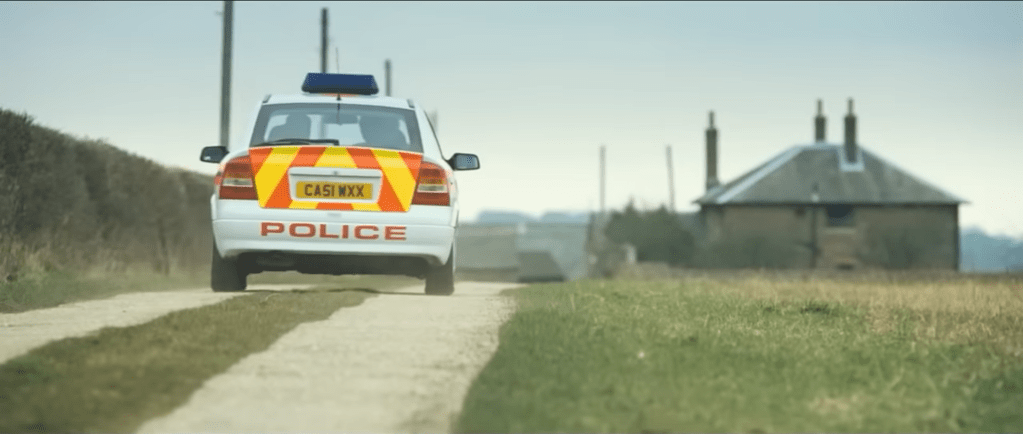
Here I am analysing the cinematography of an interesting scene in the film “Hot Fuzz” (2007) by director Edgar Wright. This particular scene in “Hot Fuzz”, we see a group of police inspectors visiting a gentleman on a farm to talk to him about the removal of hedges. The very first shot (the establishing shot) is a very long shot (VLS) which captures the car cruising at high speeds along a road in the countryside. This is the introductory component which introduces the police car (and so the presumed officer/s inside the car). The shot also shows the audience the geographical location, giving them an idea as to where the scene is going (a beautiful countryside may mean a happy joyous scene). After this first shot, it follows into a wide shot (WS) of the car approaching the farm, and one of the main subjects in this scene.
Shot three is then a medium close up shot of the three officers and dog driving in the car, we can notice their facial expressions and conversation lead by the main subject, suggesting that they are there for a menial uninteresting task, as he doesn’t seem too convinced, they all need to be there. Shot 4 is then very interesting as it is a close up which means us as the viewer gets to see all the details of the current subject. It is an intimate shot without being too close to be unnecessarily off putting, but then also close enough to not leave out details which could be pivotal to the scene
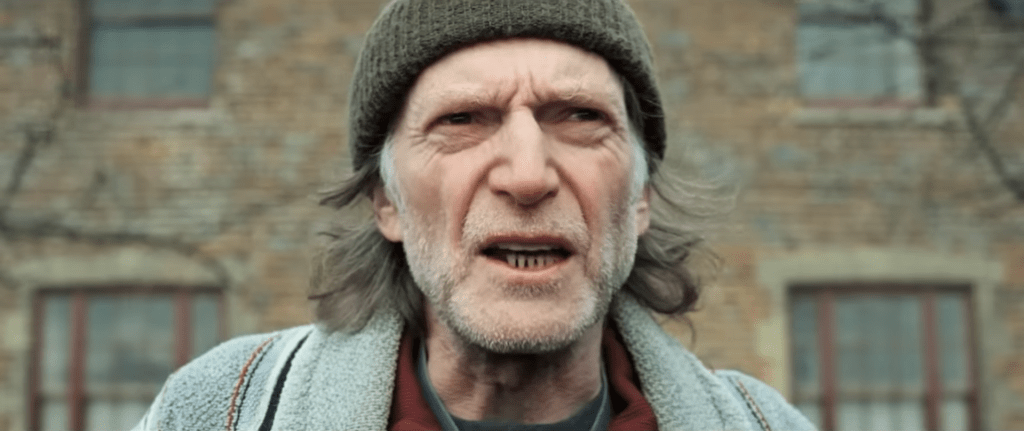
The scene’s shots are then flicking back and forth between medium close ups of the three officers and medium shots of the other man. This quite obviously shows conversation between the two groups encapsulating each of their different perspectives and body language. The scene flicks to a master shot quickly which helps us to perceive the subjects in relation to the geography we have seen from the previous shots. And helps us to notice the relationship between the two groups. For example, they’re stood on either side of a fence for these shots, telling us that the groups are not too friendly with each other, even some hostility, probably towards the police as a political connection, due to the man holding a firearm throughout the scene. From here the scene then changes to a different location. Throughout this scene though, many shots are taken, all roughly using the same type of shots. As the scene progresses, we see how the attitudes and perspectives of the police officers do not change at all, and this indicates to the viewers even more what these characters are like, and they can see how the subjects overall character arc develops.
 Flynn's Film Blog
Leave a comment