Damsel (2024) by Juan Carlos Fresnadillo
In Damsel, there is a clear fantasy narrative which, while being quite unoriginal, it proves well to analyse for narrative theory. Fresnadillo has used numerous narrative theory techniques, such as Propp’s Character functions, Todorov’s Linear Narrative Structure, and Vogler’s Hollywood three-act structure.
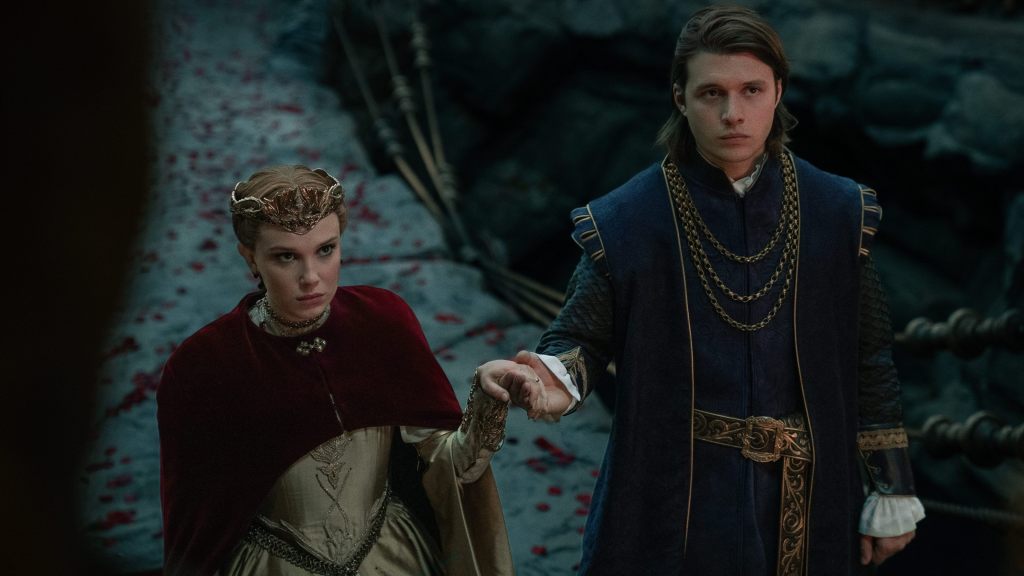
Vladimir Propp highlighted 7(8) character functions. Fresnadillo doesn’t completely follow these but certainly uses them to help create a textbook story. The first Character function is the Hero. The Hero in Damsel is certainly Elodie, she is thrust into a dangerous situation, then must survive, escape, and ultimately confront both the dragon and the corrupt royal family that sacrificed her. Next is the Villain, who seeks to destroy the Hero. In this case, the villain could be seen as both The Aurean royal family and the Dragon. The Aurean family/Queen Isabelle serve as the villains as they orchestrate a cruel ritual, betray Elodie, and perpetuate a sacrificial system to maintain power. The dragon also initially functions like a villain: it’s the terrifying force to be feared, the “monster” to be overcome or reasoned with. Then there is the false hero who seems to help the hero but is actually a crucial factor to the fall of the hero. Prince Henry could be seen as a kind of “false hero” (or at least a betrayer). He is outwardly the charming prince, but complicit in the ritual and wields hidden cruelty. He’s not a genuine saviour. The next few are the helper, dispatcher and donor, these are the people who contribute to the success of the hero. You could argue that Queen Isabelle functions somewhat like a dispatcher: she sends (or lures) Elodie into this sacrifice ritual under false pretences. However, Lord Bayford (Elodie’s father) might also play a dispatching role by encouraging/facilitating the marriage, though his motivation is complicated (his duty to his people against the love for his daughter.) The glowing slugs/worms in the cave act like a donor, they heal Elodie’s burns, enabling her to continue her journey. Later, the dragon itself becomes a helper, after Elodie unmasks the truth, she heals the dragon and gains its trust, turning a classic “monster” into an ally. Finally, there is the princess and the princess’ father, which logically would be Elodie and her father, Lord Bayford. Elodie is the “princess” trope, but flipped: she’s not just a prize to be won, she’s sacrificed, then becomes active, resourceful, and saves others (including herself and her sister (perhaps suggesting her sister, Floria, is the actual “princess”)). And Lord Bayford as the Princess’ father, he organises the marriage of Elodie and Prince Henry. These last two are extremely conventional as the princess and the princess’ father are actually the princess and her father.
Using the conventional Todorovian linear narrative structure, we can identify which parts of the story Fresnadillo labelled each one as. These are as follows, the equilibrium, the disruption, the quest (recognition), the conflict (repair), the new equilibrium. Firstly, the equilibrium is Elodie’s life in her kingdom before the wedding. The disruption is the wedding betrayal and the ritualistic sacrifice to the dragon. Then comes the quest (recognition) which is Elodie’s realisation about the truth about the Aurean kingdom, the past sacrifices, and the dragon’s motive. Next is the conflict (repair), her escape, survival, confrontation, rescuing Floria, and toppling the Aurean royals. Now finally, is the new equilibrium, with Elodie and her family returning home with the dragon and establishing a new, peaceful order. I would say that this film is structured very conventionally but with just a few anomalies. For instance, the equilibrium at the start is already unstable. Todorov’s equilibrium is normally peaceful, safe, and genuinely stable, but here its not. Elodie’s family is already struggling financially. The marriage is not romantic – it’s a political trade. The Aurean kingdom feels “off” even before the disruption. This means the equilibrium is fake or fragile, which is more modern than Todorov’s original idea of a clear, peaceful starting point.
Vogler’s three-act structure is very common amongst modern films, here in Damsel it is presented well. In Act 1, it is split into three parts, the hook, inciting event, and the 1st plot point. During the hook, Elodie’s family struggles to survive in their harsh kingdom; the sense of desperation and responsibility sets the tone. We see Elodie caring for her people – establishing empathy. This hooks us emotionally and sets up her moral character before the plot begins. In the inciting event – a representative of Aurea arrives with the offer of marriage to Elodie. This triggers everything: The alliance, the journey, the deception, the sacrifices. It’s the moment the narrative begins. The last of the first act, the 1st plot point. The wedding betrayal and Elodie being thrown into the dragon’s pit is the first plot point. This is the point where she crosses into the “new world” (the cave). Here the real conflict begins and there is no going back. This beat marks the irreversible shift. The first pinch point is the beginning mark of act 2. Here, it is Elodie’s first direct encounter with the dragon in the caves. This reinforces: The danger, the scale of the threat and the fact she is alone and outmatched. This is a classic pinch point – antagonist pressure increases. Now its the midpoint (second plot point), Elodie discovers the truth about the past sacrifices and the Aurean family’s generational ritual. She pieces together the carvings and bones, and realises the kingdom intended to kill her. From this she pulls through and escapes the cave. Next is the last of act 2, the second pinch point. Floria is captured and prepared for sacrifice by Queen Isabelle. Elodie realises the threat isn’t just to her – it’s spreading to her family. The stakes jump again. We then finally move on to act 3, where we reach the climax and see the resolution. The third plot point is that Elodie must re-enter the cave to rescue her sister, and while doing this befriends the dragon. This leads onto the climax, where the dragon turns against the Aurean royal family and destroys them. Elodie and the dragon unite against the corrupt system, and the centuries-long cycle of sacrifice ends. This is a very conventional way of using the three-act structure, which gives the spectator a satisfying film and ending.

 Flynn's Film Blog
Leave a comment