Alien (1979) by Ridley Scott
In this chosen scene from alien (1979) we see Harry Dean Stanton’s character Brett get killed by the alien, and the lighting is very interesting in this scene to analyse. In the very first few seconds of this clip, lighting is shining from the left side of the shot onto the left side of Bretts face. In this medium close-up, you would call this type of lighting as a ‘Fill Light’, as this light is placed to the side of the subject, to fill out the shadows and balance the ‘Key Light’. This low-key lighting emphasises the contours of the subject by throwing areas into shade, and also this low-key approach creates a sense of claustrophobia and mystery.
In this next shot, brett has moved towards the centre of the room where there are chains hanging, water falling and light shining down from above. This type of lighting is known as top lighting – this highlights the subjects facial features and shows their key expression in the moment. This shot was a close-up and shows only his head, and so could also be a reaction shot, which is emphasised by how the lighting is placed above him. The wet, glistening look from his sweat and the falling rain is enhanced by the way the top light reflects off the skin. It makes the environment feel hot, humid, and uncomfortable, while also hinting at fear or exertion.
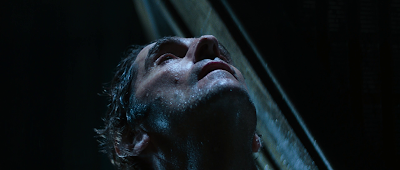
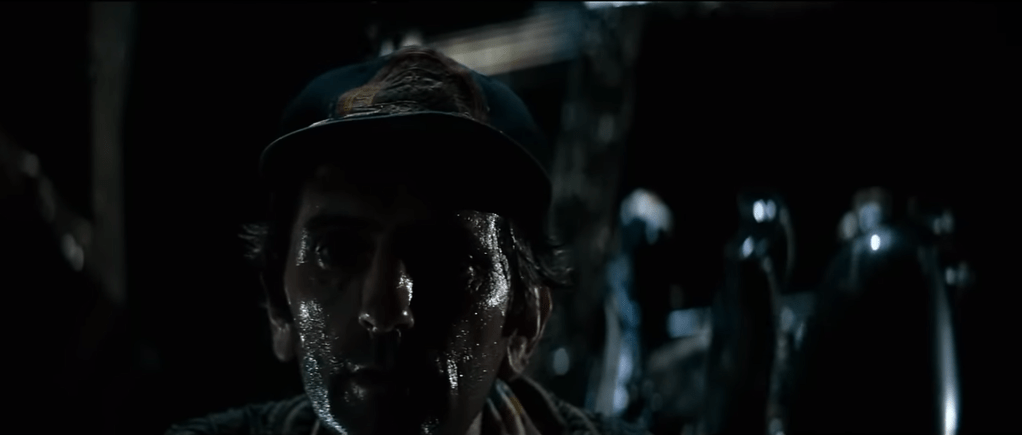
After brett moves on from this shot, we later get to see him after he’s found the cat (Jonesy) he was searching for, and in this shot, both Brett and the alien (xenomorph) are seen, with the alien being more highlighted through the extreme ‘Low-Key Lighting’ as well as the ‘Chiaroscuro Effect’ on Brett’s face, this takes the spectators point of attention away from Brett, and onto the imminent death the alien symbolises. The alien’s bio-mechanical design (the ridges, gloss, and curves) blends almost seamlessly with the industrial machinery of the Nostromo. The lighting gives us just enough of a reflective highlight to hint at its presence, but not enough to clearly define its shape. This forces the spectator to “search” the frame, creating suspense. In the earlier shot, the sense of dread came from his own vulnerability. Here, the light finally tips us off to the presence of his killer. It’s like the lighting scheme walks us through the process of realisation: first fear, then revelation, then death.

 Flynn's Film Blog
Leave a reply to draeburn Cancel reply